

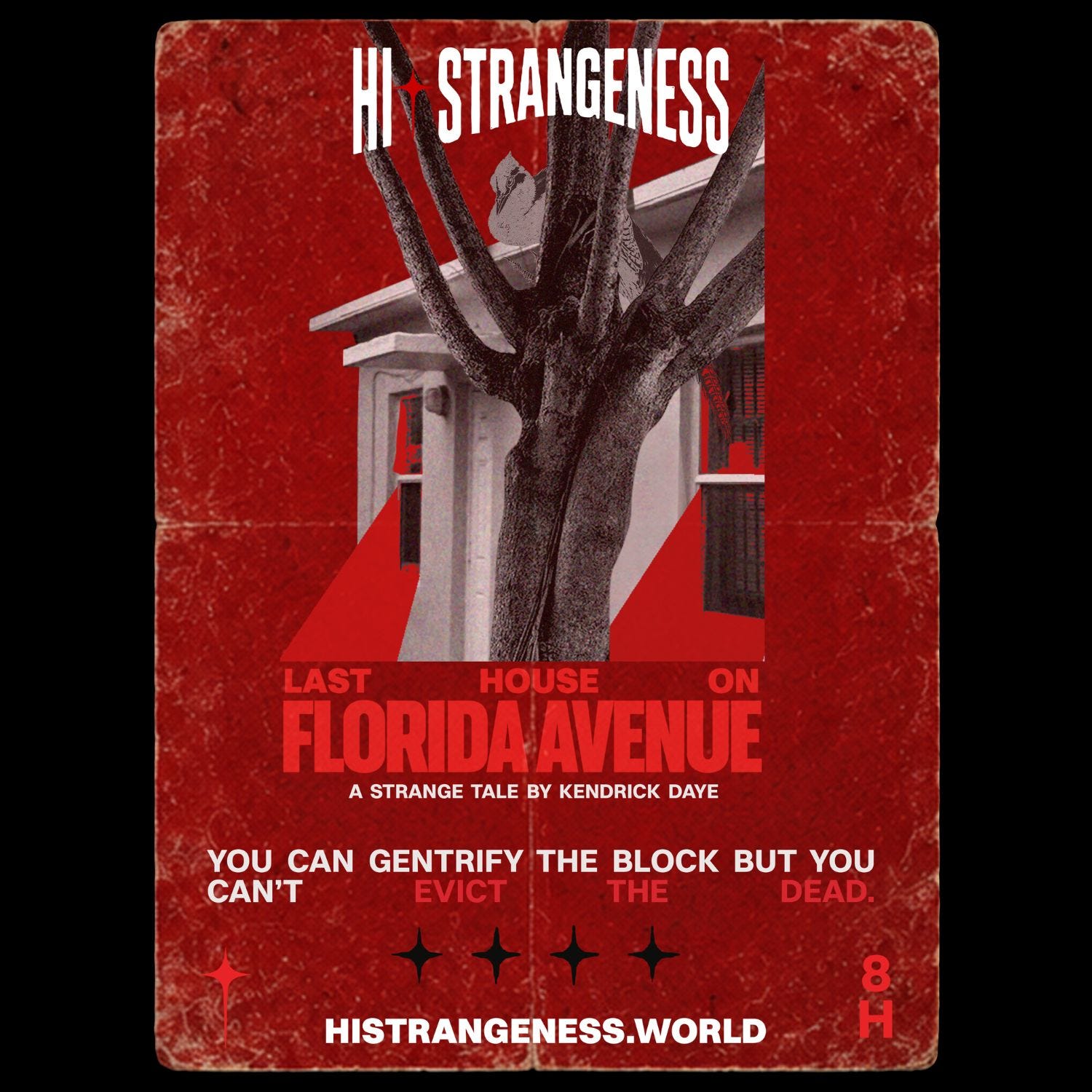
LAST HOUSE ON FLORIDA AVENUE
You can gentrify the block. But you can’t evict the dead.
RICHARD WASN’T AFRAID of ghosts. He’d seen horrors long before puberty. And real horror, he learned then, didn’t need ghouls or poltergeists.
It only needed a white man with a ledger and a warrant.
He still woke in cold sweats to that dark living room. Shadows of the landlord and sheriff looming in the window. The lock turning, the front door opening slowly, like it had all the time in the world, because it did. It was Richard and his mother who were out of time.
And then he sprinted, through the kitchen, out the back door, into the wet heat of the West Grove, past rows of identical pink flattop duplexes, into arms that waited. Miss Marie stood up from her chair and caught him before the ground did.
“Lil’ Boy Blue,” she said. “You runnin’ from ghosts again?”
They used to call them the projects, but they were home to many. Over the years they’ve been excavated, bulldozed, and sold off in smaller blocks with bigger price tags. All except one. The last house on Florida Avenue. Miss Marie’s house, sits in the middle of the stalled construction unbothered.
Now an adult, Richard stands on the porch, Gucci sunglasses hiding his cold eyes. If gentrification is a virus, Richard is patient zero in a three-piece suit. Before he can even raise a hand to the door, it swings open.
“Eh, eh, Lil’ Boy Blue,” Miss Marie says.
She doesn’t ask what he’s doing here. She just hugs him like the years never happened, her gold peacock necklace pressing into his chest.
Inside, the walls are lined with photos: him and Claude at eight, missing a front tooth, holding a melted fruit cup, his mother on the porch beaming. Richard’s jaw tightens.
Miss Marie drips in from the kitchen. She hands him a glass of tea and sits at the table
“You look damned good boy,” she says, sizing him up. “Claude’ll be back in an hour if you want to wait a bit. I know he’d love to see you.”
Richard pulls out a cigarette. “I won’t be long.”
Miss Marie watches him with a half-smile. “You know I don’t allow no smoking in here.”
He clears his throat and tucks the cigarette back into the pack.
“Listen, I’m heading up the new development,” he says. “Your property’s the last holdout. My firm is prepared to offer you significantly more than the previous estimates.”
She eyes him, then the briefcase. “I see what this is,” she says.
“I’m offering you a future, Marie,” Richard says.
“Miss… Marie,” she corrects him. “And I have a future. A legacy. It’s this house.”
Richard leans forward. “You don’t want to fight this in court. They’ll take it eventually. I’m just trying to make sure you good.”
Her face hardens, her voice sharpens like a blade. “Good?” she stands, “Ain’t nothing ‘bout this good.”
“Black folk build something out of the scraps crackas leave us, and then they come back and want to take that too,” she barks. “It’s shameful,” she says, nodding to herself.
Suddenly she gasps and grabs at her chest. Her mug slips and clatters. She collapses hard, head cracking against the concrete floor. Richard doesn’t flinch. He kneels beside her, not out of grief, but calculation. He places two fingers on her neck. Nothing but silence and the soft ticking of the wall clock.
He reaches into his briefcase and pulls out the forged deed transfer paperwork, already filled out. He removes a pen from his jacket pocket, positions it carefully, curling her cold fingers around it like he’s guiding a child through their letters. With the ease of practiced fraud, he drags her hand across the signature line, Marie Louise Beauvais.
Her hand falls back to the floor with a soft clap. Richard straightens his jacket, walks to the fridge, and pours himself another glass of sweet tea. He sits in Miss Marie’s armchair, crossing one leg over the other. The photos of him as a boy watch from the mantel as he finishes his tea. After a moment, he calmly pulls out his phone and dials 911.
“Yes,” he says, voice smooth. “I’m calling from West Grove. I came to see bout my godmother… she not breathing!”
A pause. “Yes. I’ll wait for someone to arrive.”
The funeral is swollen with bodies. Women in hats, men clutch handkerchiefs, everybody looks like they’re trying not to cry, or trying too hard. Everybody except Richard. He is a shadow among mourners, performing a duty scripted by lawyers. Show your face, they said. Pay your respects, they said. So he nods, though he does not know the names he nods to.
The preacher’s voice rolls like thunder. He preaches of glory. Homegoings. Promises of forever. But Richard’s eyes are elsewhere. They rest on Claude, hunched in the front pew, fury folded into his shoulders.
After the benediction, Richard slides beside him.
Claude does not look up. “Didn’t think you’d come.
“Of course I came,” Richard lies.
“She bragged about you every day, you know.”
Richard is silent. Silence hangs heavier than anything he could say in this moment.
Then Claude smiles, a sharp thing. “I’m glad it was you who found her.”
His hand touches Richard’s shoulder, as if to bind him in kinship. Richard breaks it. He draws an envelope from his pocket and lays it like an offering.
“Your mother deserved this. And so do you.”
Claude opens it. His eyes stumble on the zeroes. “This is blood money.”
He leans close. His breath reeks of rum and rot, his words of fire: “You think I want a condo while my mama sinks into the dirt?”
Richard reclines, untouched. “What else could you want?”
Claude rises. “I want you to hurt.”
He bends, whispering against Richard’s ear, voice shaking the lights, “Se pou ou pa janm dòmi anpè nan kay ou vòlè a.”
He spits, not on Richard but at the aisle itself. He stumbles past the coffin, past Miss Marie’s defiant stillness, out into the open air. Richard does not move. He lights a cigarette and looks up at the sunlight shining in the stained glass.
Six months pass, and Miss Marie’s house is still sitting there like it owns the block. Richard’s company sends crews, one after another, but the house refuses them.
The first crew vanished. Their trucks were found idling in the street, keys in the ignition, tools untouched. The second crew quit mid-swing. They just threw down their hammers and sprinted barefoot out the house, down the block, screaming about a voice humming in the walls. The third sent an email at 9:07 a.m. on their first day that simply read: “There’s blood in the insulation, it’s warm.”
These days Richard’s office always smells like stress and Starbucks. The board bites at him through the speakerphone, their voices sharp with greed: “We’re months behind…” “You said this would be cleared by Q2…”
He kills the call mid-yell, crushes a cigarette against his desk, then lights another. “Oh Emm Gee,” he laments as he blows smoke in the air. “Everyone get off my ass unless you have a dick in it.”
His assistant appears in the doorway, tablet in hand, frown carved into her face. “I told legal you’re not autistic. You’re just an asshole.”
He shrugs as she thrusts the tablet toward him. “And you’re out of options. No crew from here to Orlando will touch the property on Florida Avenue. They say it’s haunted.”
“Haunted?” he says with a chuckle, already turning back to his emails. “I don’t believe in ghosts.”
“Maybe you should.”
He smirks. “You want to hear a scary story? Your rent is due, your account is in the negative and your landlord is at the door with the sheriff,” Richard says, putting his cigarette out.
Then he grabs his briefcase, slides his shades on.
“Where are you going?” she asks.
He stands up. “To the property.”
“To do what exactly?”
Richard pauses, already walking out. “I’m going to knock the damned thing down brick by brick if I have to.”
Richard’s Escalade turns onto Florida Avenue, black shining against the ruin. At the far end of the block, Miss Marie’s house waits. Patient, crouched like a gator with its belly in mud, waiting for the slip of a foot.
But it is not the house he sees first.
It’s the peacock. Standing proud on the roof, tail folded, eyes jeweled and ancient.
The second thing he sees are the windows, chained with iron bars. He doesn’t remember them always being there, but memory betrays him. They were not for thieves. They were prison-bars, to keep something in.
As soon as he opens the car door, Bruno, his old Frenchie, runs straight for the porch as if answering a call. Richard follows, cigarette in hand. He lights it, or tries to. The lighter flickers. Click. Click. Nothing.
“Figures,” he mutters, tossing it to the sidewalk.
He heads down the block, past the fenced-off lots and stalled construction sites, each one looking more like a crime scene than progress. He hits the corner store, the last one left, not yet flipped into a kale smoothie joint or some overpriced wine shop. That’s where he sees Claude. He’s bent on a milk crate by the freezers, whispering words only he can hear. His beard grows wild, gray dusting the edges. His shirt is a map of holes and stains.
“Claude?” Richard raises his eyebrows. “You blew through all that money already?”
Claude looks up. His eyes are wide and watery, but not surprised. Just tired. He gives Richard a smile with no teeth. “I’m grieving.”
Richard crouches down a little. “Look, I’ve got a job for you. Help me clean up the place.”
Claude jerks back like the word itself is dirty. “Charity?”
“Closure,” Richard says, straight-faced.
“No.”
“I’m serious.”
“I know you are. That’s why I’m saying no.”
Richard frowns. “What don’t you get?”
Claude wipes sweat off his lip with the back of his hand. His eyes burn a little brighter now. “You don’t see it yet?”
“See what?”
“The house. Breathing. Watching.”
Richard laughs, too loud. “You sound slow.”
Claude leans forward, voice dropping to a whisper sharp enough to cut. “Remember when we were kids? You said it was safer in our house than yours. You called it magic.”
Richard rolls his eyes. “I was eleven.”
Claude grins, a grin that doesn’t reach his eyes. “But you were right.”
Richard stares up at the house before he climbs the steps. It stares back. The windows look like eyes, waiting for him to blink first, a contest he is bound to lose. He drops into the porch chair, cigarette pinched between his fingers, smoke curling in lazy shapes. He blows out a lungful. For a second it almost feels normal. The other chair sighs a long, aching creak. Like a body taking a seat next to him. He stills.
“…Hello?”
The house answers only with the noise of insects, their high keen in the grass, and the distant hiss of cars. Inside Bruno begins to bark up a storm.
Richard jumps, and glances at the window and sees a flicker of movement, like someone slipping past the curtains. He flicks the butt into the yard, shoves the door open. Bruno’s in the living room, growling toward the couch. Richard grabs the nearest thing, a hammer, and edges forward.
The silence rips apart in a scream. The damn peacock bursts out, wings slamming, knocking over lamps, shrieking like hell itself. Richard swears, swings, drives it toward the back door. By the time it hits the floor it’s just a carcass, and Richard’s left holding it, chest pounding. Without a word, he marches to the curb and dumped it into the trash bin, slamming the lid shut.
That night, like all nights, Richard buries himself in work. Laptop open, emails pulled up, contracts glowing white in the dark.
Bruno shifts at an empty corner. His ears pin. A low growl rolls out of him. Then he barks, loud and sharp, not warning so much as testifying, something is here with us.
Richard curses. “Bruno shut it.”
But the dog keeps barking at the same empty corner. Richard pushes up, ready to lose his temper until he hears it. A hum of a familiar tune. His mouth goes dry. It drifts through the walls like perfume. He lifts his phone and switches to camera mode.
He takes the photos, one by one. First, emptiness. Second, a blur. Third, the blur becomes a shape. Human? Fourth, the shape grows a face, eyes hollow as pits, mouth dragging wide.
He lowers the phone, trembling. One more click and the figure leans inches from the lens.
And when he turns, he sees Claude. His mouth is open in an impossible scream that makes no sound. Richard staggers back, knocking his laptop to the floor. Bruno whimpers, wedges himself behind the counter, shivering. Claude flickers, then disappears yet the kitchen still feels crowded.
…
The caw of the peacock lifts Richard out of his sweat-slick dream. He sits on the couch, chest heaving, shirt clinging wet to his skin. Every light is still on inside the house.
Outside, through the warped glass of the living room window, the peacock stands on the porch railing, watching him. He doesn’t blink until it caws again and flaps its wings and disappears to the roof of the house. Richard curses under his breath.
Later, he walks the block again, stepping over puddles that shimmer oil-slicked rainbows and passes the same cornerstore. A few men sit outside under the awning, drinking beer in paper bags.
He asks them, flatly, “Y’all seen Claude?”
A man with missing teeth lifts his chin. “He dead.”
Richard stares. “What? I just saw him last night. In my house”
The man spits, yellow spit sinking into the gutter. “Couldn’t be, he died last night.”
Thunder rumbles in the distance and the wind begins to pick up.
Another voice pipes up. “Chu talkin’ bout Miss Marie house?”
“She doesn’t own it anymore,” Richard says.
Thunder rumbles, closer now. The wind kicks trash down the street. The old men begin to cackle.
“Can’t evict the dead boy,” the one with the missing teeth mutters.
“Best get on now,” one says. “A storm comin’.”
By the time Richard reaches the house again, the sky has split wide.
Rain lashes sideways, soaks him until his blazer, shoes, hair, all hang heavy. Lightning claws the horizon, and there, on the roof, perched again, is the peacock. The next flash brings more than light. In the windows he sees them: Miss Marie, Claude, ghosts of families pushed out for a Whole Foods and a dog park.
He kicks open the door and stomps in, drenched and seething. “You think you scare me?!”
The house groans deeply. Its ribs expand. Its walls breathing. Richard seizes the sledgehammer waiting on the floor. He swings at plaster, at memory.
“I made something of myself!” he spits as if that can wash the ache of selling his boyhood bike so the lights stayed on. As if the house didn’t remember.
He swings. The wall groans. A crack opens, not just in the concrete, but in him.
He’s eleven years old again. Watching an envelope slide under the door, red letters screaming EVICTION. His mother sprawled on the bed, lipstick smeared, perfume drowned in the scent of another man’s sweat.
He drives the hammer into the wall until plaster explodes like snow. His arms shake. Because it’s not the house that’s breaking. It’s him.
The house shivers. Hands colder than death reach for him, tug his arms, press his throat, anchor his legs. He screams, but the scream belongs to another mouth. Grief howls through him, centuries of grief. And then stillness. The storm dies. The house exhales.
They gather: Miss Marie, Claude, and the other ghosts of Florida Avenue. Faces not hateful, but heavy with disappointment.
They reach, not to break, but to remind him of who they were, who he was.
Richard stumbles free, bolts outside, Bruno clutched tight. He shoves the dog into the car, rips a gas can from the trunk. The liquid sloshes as he circles the house. In the windows, the ghosts watch.
On the roof, the peacock gleams, unmoving.
Richard strikes a match.
One word could save him, sorry, mercy, anything, but his lips curve to a sinister smile.
He throws the match at the house, but the fire turns on him like an exotic pet.
It wraps around his body, licks up his legs, swallows his scream and wraps him in one final, fatal embrace. His flesh melts. His knees buckle and he drops to the ground.
What should have been ash is whole.
The grass grows up wild around the porch steps of Miss Marie’s house, and a raggedy “For Sale” sign leans by the walkway. A bright rectangle of promise with Richard’s picture on it, frozen in his suit and smile, grinning at the living as though the house behind him is not already full of the dead.
Children ride by the last house on Florida Avenue, testing their own courage. They circle, bikes rattling, laughter sharp as tin.
“Bet you won’t knock,” one says, and the words sound older than he is.
The smallest boy steps forward. He lifts a shaky hand toward the door but does not touch it. In the window, the curtain stirs. Behind it: a figure, flickering like a bad light bulb.
It’s Richard.
Eyes tar-black, his presence more shadow than flesh. The boy stumbles back. The others scatter, wheels spinning in the road.
The peacock stands where it has always. It throws its head back and its caw splits the air.
On the porch, the chair rocks, slow, steady. And they say you can still hear that humming.